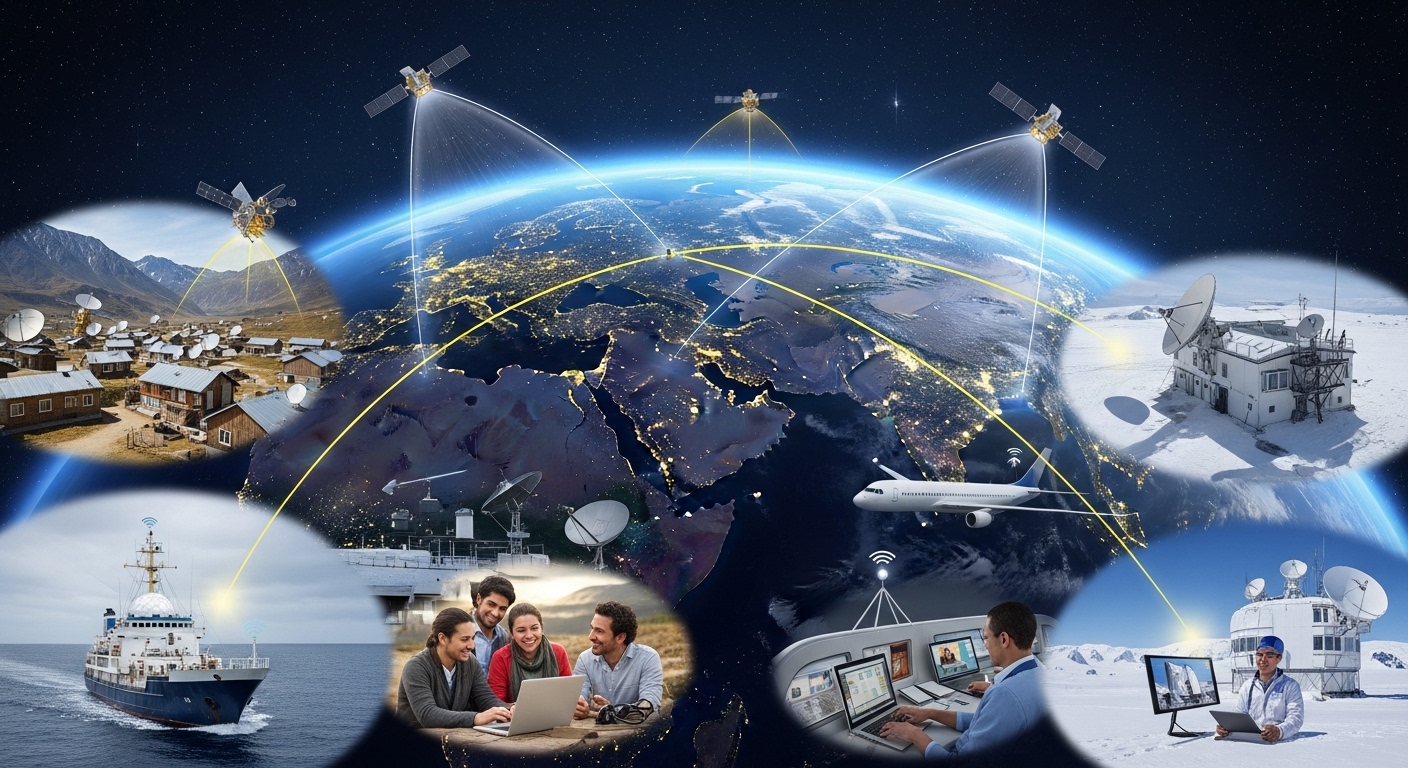
Satellite internet is rapidly transforming how people around the world access digital services and online communication. In many regions, especially rural and geographically isolated areas, traditional broadband infrastructure such as fiber-optic cables and cellular towers is difficult or uneconomical to deploy. Satellite internet addresses this challenge by delivering broadband access directly from space, enabling users to connect without relying on extensive ground networks. This advancement in communication technology is playing a crucial role in expanding global connectivity and reducing the long-standing digital divide between urban and rural populations.
The importance of reliable internet connectivity has grown significantly in recent years due to remote work, online education, digital healthcare, and e-commerce. Regions that previously lacked stable connectivity can now participate in the digital economy through space internet solutions. As satellite technology evolves, higher speeds and lower latency are making satellite internet increasingly competitive with terrestrial broadband options.
How Satellite Internet Technology Works
Satellite internet operates through a network of orbiting satellites that communicate with ground stations and user terminals. When a user sends or receives data, the signal travels from a satellite dish or modem to a satellite in orbit and then to a ground station connected to the global internet backbone. The response follows the same path back to the user.
There are three primary types of satellite orbits used in communication technology: geostationary orbit (GEO), medium Earth orbit (MEO), and low Earth orbit (LEO). Traditional satellite internet relied mainly on GEO satellites positioned far from Earth, which resulted in higher latency. Modern space internet systems increasingly use LEO satellites that orbit closer to the planet, dramatically improving performance and reliability.
Below is a comparison of satellite orbit types and their connectivity characteristics.
| Orbit Type | Approximate Altitude | Latency Level | Coverage Area | Typical Use in Broadband Access |
|---|---|---|---|---|
| GEO | ~35,786 km | High | Very wide | Traditional satellite internet |
| MEO | 2,000–20,000 km | Medium | Regional | Navigation and communication |
| LEO | 160–2,000 km | Low | Smaller cells | Modern space internet systems |
The shift toward LEO satellite constellations is a major driver behind the growing effectiveness of satellite internet in delivering fast and stable broadband access globally.
Expanding Rural Connectivity and Bridging the Digital Divide
One of the most significant impacts of satellite internet is its ability to expand rural connectivity. Rural and remote communities often face barriers such as rugged terrain, low population density, and high infrastructure costs that prevent traditional broadband deployment. Satellite internet eliminates the need for physical cables across vast distances, allowing connectivity to reach farms, deserts, mountains, forests, and islands.
Access to reliable broadband enables rural populations to participate in digital education, telemedicine, online banking, and e-commerce. Students can attend virtual classes, healthcare providers can offer remote consultations, and small businesses can reach broader markets. This transformation not only improves quality of life but also supports economic development in previously underserved regions.
Satellite-based communication technology also supports disaster-prone areas. When natural disasters damage terrestrial networks, satellite connections can restore communication quickly, enabling emergency response and coordination. This resilience further strengthens the role of space internet in global connectivity infrastructure.
Role of Satellite Internet in Economic and Social Development
Broadband access is now considered a critical driver of economic growth and social inclusion. Countries with higher connectivity levels tend to experience faster innovation, improved productivity, and better access to services. Satellite internet contributes to these outcomes by connecting populations that would otherwise remain digitally excluded.
In developing regions, satellite connectivity supports digital government services, financial inclusion through mobile banking, and access to global information resources. Entrepreneurs in remote areas can run online businesses, access cloud tools, and engage in international trade. Farmers can use weather data, market prices, and precision agriculture tools delivered through satellite-enabled networks.
Healthcare systems also benefit from improved connectivity. Telemedicine services allow remote diagnosis and monitoring, reducing the need for long-distance travel. Public health campaigns and education initiatives can reach wider audiences through connected platforms. As a result, satellite internet strengthens both economic opportunity and social development.
Technological Advancements Driving Space Internet Growth
The rapid growth of satellite internet is closely linked to technological innovation in communication technology and aerospace engineering. Modern satellites are smaller, more efficient, and cheaper to launch than earlier generations. Reusable rockets and mass-production techniques have reduced deployment costs, enabling large satellite constellations that provide continuous global coverage.
User equipment has also improved significantly. Modern satellite dishes are compact, easy to install, and capable of automatically tracking orbiting satellites. Advanced signal processing and beam-forming technologies optimize bandwidth distribution and network performance. These improvements ensure more stable broadband access even in challenging environments.
Competition among satellite internet providers is accelerating innovation and reducing service costs. As adoption increases, economies of scale are expected to make space internet more affordable, particularly for rural connectivity initiatives and national broadband programs.
Challenges and Future Outlook for Satellite Internet
Despite its advantages, satellite internet still faces several challenges. Weather conditions such as heavy rain or storms can affect signal quality. Initial equipment costs may be higher than traditional broadband in some markets. Regulatory and spectrum allocation issues also influence deployment in different countries.
However, ongoing research and investment are addressing these limitations. Improved satellite design, advanced error-correction protocols, and hybrid networks combining satellite and terrestrial infrastructure are enhancing reliability. Governments and international organizations increasingly recognize satellite internet as a key component of universal broadband strategies.
Looking ahead, satellite internet is expected to integrate with emerging technologies such as 5G, Internet of Things networks, and autonomous systems. This integration will create a more resilient and flexible global communication ecosystem capable of supporting future digital demands.
Final Thought
Satellite internet is redefining how the world connects by delivering broadband access beyond the limits of traditional infrastructure. Through advances in space internet technology, rural connectivity is expanding, economic opportunities are increasing, and communication technology is becoming more resilient and inclusive. As innovation continues and costs decline, satellite internet will play an even greater role in ensuring that global connectivity reaches every corner of the planet.