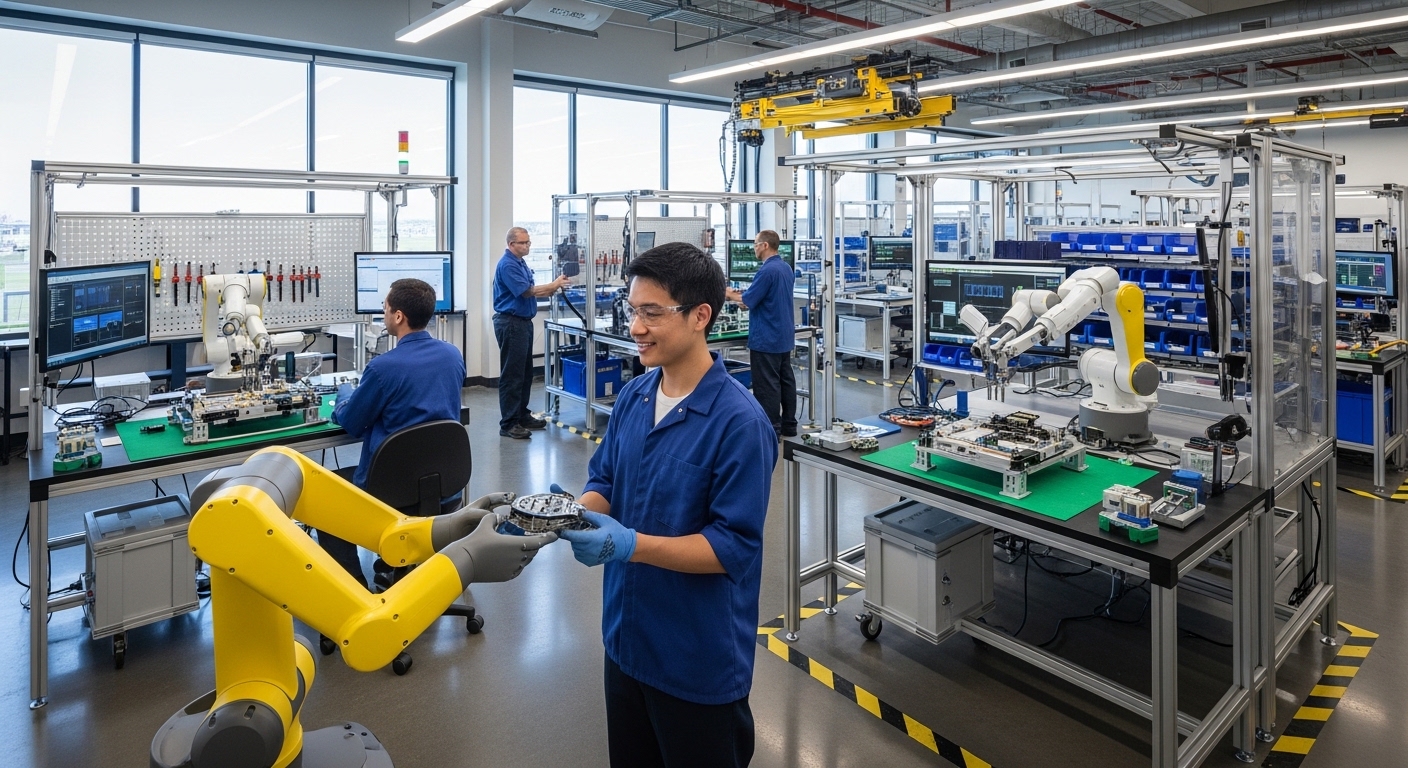
Collaborative robots, commonly known as cobots, are transforming industrial automation by enabling humans and robots to work safely and efficiently in shared environments. Unlike traditional industrial robots that operate in isolated cages due to safety risks, collaborative robots are designed to interact directly with human workers. This shift represents a major evolution in robotics trends and smart factory design, where flexibility, safety, and human–machine collaboration are prioritized alongside productivity.
Manufacturing industries are facing increasing pressure to improve efficiency while maintaining customization, quality, and workforce well-being. Traditional automation often focused on replacing human labor in repetitive tasks, but this approach sometimes reduced flexibility and required costly infrastructure changes. Collaborative robots address these challenges by augmenting human capabilities rather than replacing them. As a result, cobots are becoming essential components of modern manufacturing workflows and industrial automation strategies.
What Makes Collaborative Robots Different from Traditional Robots
Collaborative robots differ from conventional industrial robots in design, functionality, and application. Traditional robots are typically large, fast-moving machines programmed for repetitive high-volume tasks such as welding or assembly. They operate in restricted zones to prevent accidents. Cobots, in contrast, are smaller, lighter, and equipped with sensors that detect human presence and adjust motion accordingly. This allows safe human–robot interaction without extensive physical barriers.
The table below compares key characteristics of traditional industrial robots and collaborative robots.
| Feature | Traditional Industrial Robots | Collaborative Robots |
|---|---|---|
| Safety Design | Requires cages/barriers | Built-in human detection |
| Flexibility | Low (fixed tasks) | High (adaptable tasks) |
| Programming | Complex coding | User-friendly interfaces |
| Deployment Cost | High | Moderate |
| Human Interaction | Minimal | Direct collaboration |
These distinctions highlight why collaborative robots are particularly suited to modern smart factories, where adaptable production and human involvement are essential.
Enhancing Manufacturing Workflows Through Human–Robot Collaboration
Collaborative robots are redefining manufacturing workflows by enabling seamless cooperation between humans and machines. In many production processes, certain tasks require precision and endurance, while others demand judgment and adaptability. Cobots handle repetitive or physically demanding operations such as component placement, material handling, or machine tending, allowing human workers to focus on quality control, customization, and problem solving.
This division of labor improves both productivity and ergonomics. Workers experience reduced physical strain and injury risk, while production speed and consistency increase. For example, in assembly lines, cobots can hold parts steady while humans perform complex fitting operations. In packaging operations, cobots manage repetitive packing while workers oversee inspection and configuration.
The integration of cobots into workflows also enables rapid reconfiguration of production lines. Manufacturers can adjust processes or product variations without major infrastructure changes. This flexibility supports mass customization and small-batch production, aligning with modern robotics trends and smart factory principles.
Role of Cobots in Smart Factories and Industrial Automation
Smart factories rely on interconnected systems, automation, and data-driven processes to optimize production. Collaborative robots are a natural fit for these environments because they combine automation with adaptability. Cobots can be integrated with sensors, machine vision systems, and industrial Internet of Things networks to operate intelligently within production ecosystems.
In industrial automation, cobots often perform tasks such as pick-and-place operations, inspection, palletizing, and machine loading. Their ability to work alongside humans allows automation to extend into processes previously considered unsuitable for robots. This expansion of automation capability increases overall manufacturing efficiency without eliminating human roles.
Cobots also contribute to data-driven manufacturing. Sensors and software track performance metrics, cycle times, and error rates, enabling continuous workflow optimization. Smart factories use this data to refine processes and predict maintenance needs. As robotics trends evolve, collaborative robots are expected to become increasingly autonomous and connected within industrial systems.
Workforce Implications and Skill Transformation
The adoption of collaborative robots is reshaping workforce roles rather than eliminating them. Instead of manual repetitive tasks, workers increasingly supervise, program, and collaborate with robotic systems. This shift requires new skills in robot operation, programming interfaces, and system integration. As a result, workforce development and training are essential for successful cobot implementation.
Human–robot collaboration also improves workplace safety and satisfaction. By taking over hazardous or monotonous tasks, cobots reduce exposure to injury risks and fatigue. Workers can engage in more meaningful activities such as process optimization and quality assurance. This transition supports human-centric manufacturing approaches and aligns with evolving robotics trends.
However, organizations must manage change effectively to ensure workforce acceptance. Transparent communication, training programs, and participatory design processes help employees understand how cobots enhance rather than threaten their roles. When implemented thoughtfully, collaborative robots can strengthen both productivity and workforce well-being.
Future Trends in Collaborative Robotics and Manufacturing
The future of collaborative robots is closely tied to advances in artificial intelligence, sensing technology, and industrial connectivity. Next-generation cobots will feature improved perception capabilities, enabling them to recognize objects, gestures, and human intent more accurately. This will enhance natural interaction and expand the range of collaborative tasks.
Mobile collaborative robots are also emerging, combining robotic arms with autonomous navigation systems. These systems can move between workstations, supporting dynamic manufacturing environments. Integration with digital twins and simulation platforms will allow manufacturers to design and test collaborative workflows virtually before deployment.
As robotics trends progress, cobots will play a central role in flexible manufacturing systems capable of rapid adaptation to market demand. Their combination of automation efficiency and human collaboration will enable manufacturers to balance productivity, customization, and workforce sustainability. Smart factories of the future are likely to rely heavily on collaborative robots as core operational elements.
Final Thought
Collaborative robots are changing modern manufacturing workflows by enabling safe and efficient human–robot collaboration within industrial automation environments. Through advancements in cobots, robotics trends, and smart factory integration, manufacturers can achieve greater flexibility, productivity, and worker well-being. As technology continues to evolve, collaborative robots will become increasingly central to adaptive and human-centric manufacturing systems worldwide.