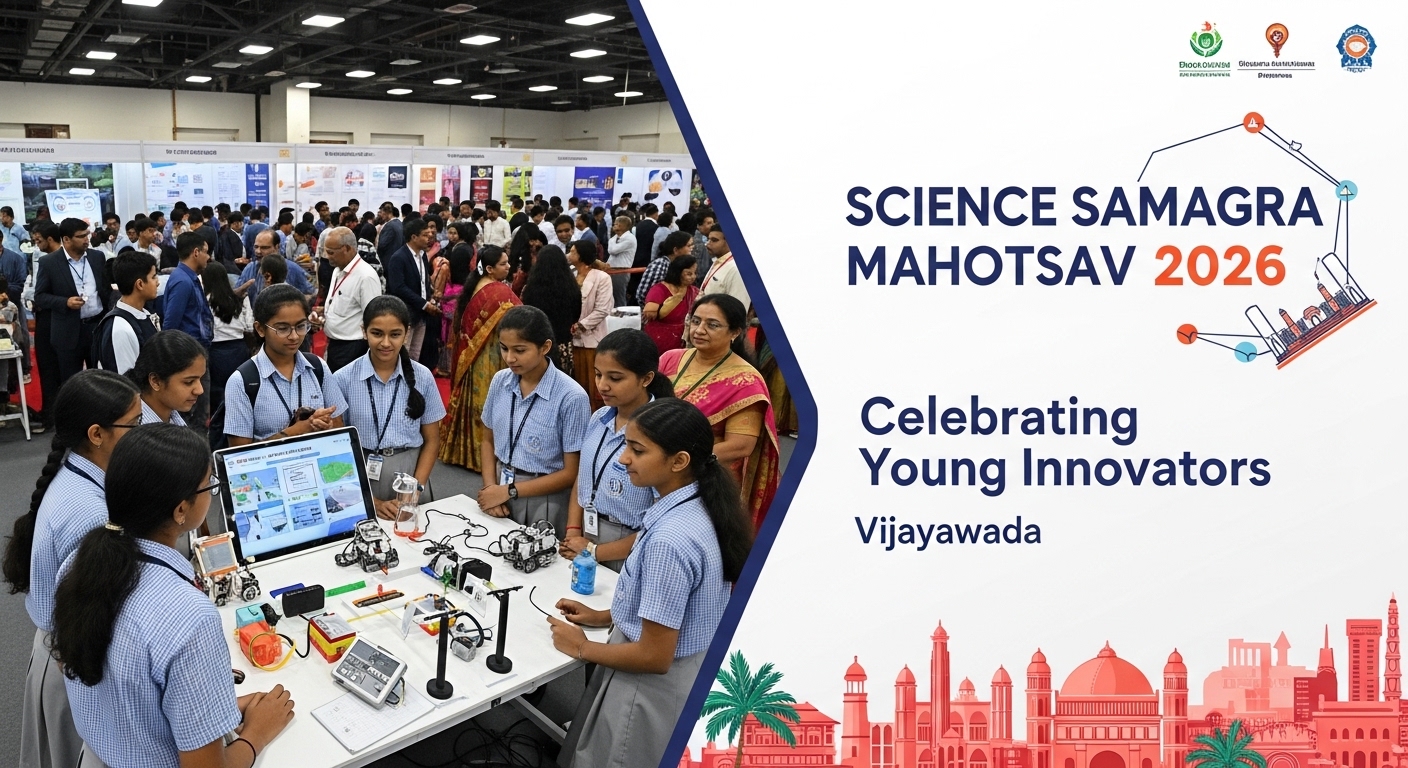
Science Samagra Mahotsav 2026 Vijayawada is emerging as a significant student innovation event celebrating scientific curiosity, creativity, and youth-driven research in India. Organized around National Science Day, the event brings together students, educators, researchers, and science enthusiasts to showcase projects and ideas addressing real-world challenges. Science exhibitions in India have long served as platforms for young learners to explore scientific thinking beyond textbooks, and this mahotsav represents an expanded, interdisciplinary version of that tradition.
The event highlights the role of early scientific exposure in shaping future innovators. By providing opportunities for students to present experiments, prototypes, and research concepts, Science Samagra Mahotsav fosters confidence and inquiry-based learning. Vijayawada’s selection as host city underscores regional participation in national science initiatives, promoting inclusive access to scientific engagement. As India emphasizes STEM education and innovation ecosystems, events like this contribute to nurturing scientific talent at grassroots levels.
Objectives and Structure of the Student Innovation Event
Science Samagra Mahotsav 2026 Vijayawada is designed to encourage hands-on learning and interdisciplinary collaboration among students. The event typically includes science exhibitions, live demonstrations, innovation competitions, workshops, and expert interactions. Participants from schools and colleges present projects across disciplines such as environmental science, robotics, health technology, and sustainable engineering. These formats transform theoretical knowledge into practical exploration.
A key objective of the student innovation event is to connect classroom science with real-world application. Students are encouraged to identify local or global problems and propose scientific solutions. This approach promotes critical thinking and design-based learning. National Science Day themes often guide project categories, ensuring alignment with contemporary scientific priorities.
The table below outlines typical components of Science Samagra Mahotsav exhibitions and activities.
| Event Component | Description | Learning Outcome |
|---|---|---|
| Project exhibition | Student prototypes/models | Applied science skills |
| Innovation contest | Problem-solving challenges | Creativity and design |
| Workshops | Skill-building sessions | Technical knowledge |
| Expert talks | Scientist interactions | Career awareness |
| Demonstrations | Live experiments | Concept clarity |
These components collectively create a comprehensive science exhibition India platform for experiential learning.
Role of National Science Day in Promoting Youth Science
National Science Day provides thematic and symbolic context for Science Samagra Mahotsav 2026 Vijayawada. Observed annually in India to commemorate scientific achievements, the day emphasizes public engagement with science. Schools and institutions across the country organize exhibitions, lectures, and competitions to inspire scientific interest among students. The mahotsav expands this celebration into a large-scale regional event focusing on innovation and collaboration.
Linking the student innovation event with National Science Day reinforces scientific awareness and participation. Students gain recognition for their work, while educators and policymakers observe emerging talent and ideas. The association also encourages continuity, as students may refine projects for higher-level competitions or research opportunities. Such events demonstrate how national observances can translate into practical educational platforms.
National Science Day celebrations often emphasize themes such as sustainability, health, or technology. Aligning projects with these themes ensures relevance and societal impact. Science Samagra Mahotsav thus serves as a bridge between national science priorities and student creativity.
Impact on Student Learning and Innovation Culture
Participation in science exhibitions like Science Samagra Mahotsav 2026 Vijayawada significantly enhances student learning outcomes. Preparing projects requires research, experimentation, and presentation skills. Students learn to formulate hypotheses, test ideas, and communicate findings effectively. These experiences strengthen scientific literacy and problem-solving ability.
The student innovation event also fosters collaboration. Team-based projects encourage peer learning and interdisciplinary thinking. Exposure to diverse ideas and methods broadens perspectives. Interaction with judges and experts provides feedback that refines understanding and confidence. Such experiences often inspire students to pursue STEM careers.
Innovation culture develops when students see science as creative and impactful rather than abstract. Exhibiting working prototypes or solutions gives tangible meaning to scientific concepts. Recognition and awards further motivate exploration. Science exhibitions in India have historically inspired many young scientists and engineers, and events like Science Samagra Mahotsav continue this tradition.
Regional Significance of Vijayawada Hosting the Event
Hosting Science Samagra Mahotsav 2026 Vijayawada holds regional significance for science education outreach. Tier-2 cities and regional centers play a crucial role in expanding access to innovation opportunities beyond metropolitan areas. By organizing a major science exhibition India event in Vijayawada, organizers ensure participation from diverse schools and communities across Andhra Pradesh and neighboring regions.
Regional hosting also highlights local challenges and innovation contexts. Students often design projects addressing environmental, agricultural, or infrastructural issues relevant to their communities. Such localized innovation strengthens the connection between science and societal needs. The event can therefore stimulate regional research interest and entrepreneurship.
Educational institutions and local authorities benefit from hosting as well. Collaboration between schools, colleges, and research organizations builds regional innovation ecosystems. Public engagement activities attract families and citizens, promoting science awareness. The mahotsav thus contributes to both educational development and community engagement in Vijayawada.
Future Role of Science Exhibitions in India’s Innovation Ecosystem
Science Samagra Mahotsav 2026 Vijayawada reflects broader trends in India’s innovation ecosystem emphasizing early STEM exposure and grassroots creativity. As the country advances in technology and research, nurturing young talent becomes essential. Science exhibitions and student innovation events provide foundational experiences that can lead to higher education, research careers, or entrepreneurship.
Future science exhibitions in India are likely to integrate digital tools, interdisciplinary themes, and industry collaboration. Students may work with mentors from academia and industry to develop scalable innovations. Such integration aligns education with national development goals. Events like Science Samagra Mahotsav can serve as incubators for ideas addressing sustainability, health, and technology challenges.
Continued investment in student innovation platforms ensures inclusivity and diversity in scientific participation. Regional events complement national competitions, creating pathways for talent development. As India strengthens its scientific capabilities, nurturing curiosity and creativity at school level remains vital.
Final Thought
Science Samagra Mahotsav 2026 Vijayawada celebrates young innovators by providing a vibrant platform for scientific exploration and creativity. As a student innovation event aligned with National Science Day, it highlights the importance of science exhibitions in India for nurturing talent and problem-solving skills. By engaging students, educators, and communities, the mahotsav reinforces the role of science education in shaping future innovators and advancing societal progress.